Phew. Today was a good day. We visited Charlotte for a little while this morning, as I think I wrote earlier. She was calm, peaceful and had been so since just around when I talked to her nurse at 1 a.m. We left her in the calm, capable hands of nurse Eileen. Then we skedaddled because we all decided that too much stimulation would jinx it. We returned around 4 pm to find that the little darlin’ had been asleep almost al day. Her blood gasses were quite good, slowly decreasing all day. The last one I saw, around 7 p.m., was under 50 which is within normal range. And, her respiration rate hovered in the 25-40 range all day, also normal.
We heard that she fussed a little around 1:30 p.m., but who wouldn’t fuss when there’s been no food in +12 hours? When her feeds started again, and she’d had another good cuddle and swaddle (courtesy of Nurse Sheri, the self-proclaimed “baby whisperer”) she settled right down.
Thanks to all of you for your emails and calls in the past few days. It means so much to us and Charlotte is lucky to be so loved by all of you.
Fingers and toes crossed that tonight is a good one and that maybe, just maybe, we’ve crossed a bridge of some sort here.
Saturday, June 04, 2005


Early a.m update
1 a.m. (Yes, I called the PICU to check on Charlotte. I was awake…..): Little Charlotte was a handful after Philippe left. Fussy, inconsolable, crying for hours. The nurse told me that they had to “help” her by holding her and that intubation was imminent. You probably don’t want to get me started on the nurse and our conversation. Suffice it to say, she emphasized that if she could get the fellow alone in a room and discuss Charlotte, the baby would be tubed by morning. Did I sleep after that? You decide.
7 a.m. We got to the hospital and Charlotte was resting comfortably, swaddled in a pink blanket and looking a bit like an ice cream cone. Turns out she’s been peacefully asleep since just after my conversation with the nurse.
8 a.m. Morning Rounds: As Robin, the MD fellow, brought everyone up to speed, we learned that it had been Robin who decided Charlotte needed to be cuddled and cuddling calmed her down. The nurses thought that the baby was having brief (6-8 seconds) periods of not breathing, but Robin said that she did not experience that. This confirmed a nurse/physician disagreement from yesterday as well. Bottom line—her blood gasses are slowly improving, her respiration rate is slowly coming down to a normal range and she’s comfortable. For now. Her surgeon, Dr. Mavroudis, changed nothing except for lowering the dosage of Milrinone, the only IV drug she’s on. We’re hoping they’ll start her food again today (it was suspended in anticipation of reinserting the ventilator. So the kid is hungry. Don’t know about you, but I’m a bit of a crab when I’m hungry, too). We’ll be in the PICU at least through the weekend. If things stay stable like this, we can hope to see her grow and have a positive outlook for next week. However, as we all know, a few hours can change everything.
Friday, June 03, 2005
Hour by Hour
It seems like things change by the hour, or at least with every blood gas test which occurs about every 6-8 hours. Up, then down, then up, then down.
6/2 Morning Rounds, 7 a.m.: After they put Charlotte on the Vapotherm and the ammonium chloride, things seemed to improve a bit. Her CO2 level improved and her respiration rate seemed to be coming down. The doctors changed her prescription cocktail again—increasing her Milronone to reduce pulmonary artery pressure and adding an additional, potassium-saving diuretic for the wet lungs. Everyone was still concerned that Charlotte hadn’t gained weight. Concerned enough that she now has a weight chart taped to the crib.
6/2 Afternoon Rounds, around 4:30 p.m.: By afternoon rounds, however, the respiration rate was high again and the CO2 creeping up. Believe it or not, the doctors added Viagra (!) to the cocktail. It is apparently an oral version of the nitrous oxide that she received through the ventilator. So, now, Baby Charlotte has used K-Y jelly (to attach a bow to her head), has had a morphine habit and a meth cure, and is on Viagra. Talk about living the high life early!!
6/3 Morning Rounds, 7 a.m.: In morning rounds today, the doctors seemed pleased with Charlotte’s progress. Her respiration rate was down in the 40-60 range and her CO2 level was improving. She gained weight, too! From 2.39 G to 2.6 G. 200 grams is, of course, a huge weight gain and probably a scale issue—20-40 grams would be normal weight gain.
As the nurse practitioner put it to me at 8 am this morning: Yesterday at 4 pm, Charlotte was tracking toward needing to go back on the ventilator and this morning she was tracking more toward not needing to go back on the vent.
Well, like Chicago weather, wait a while and things change.
6/3 1 p.m.: Lori, the nurse practitioner, called me at home. Seeing “Children’s Memorial” on the caller ID made my heart stop. The scoop—with the noon blood gas test, Charlotte’s CO2 level was up again. While her respiration rate is not creeping too high yet, her breaths are shallow. So….they are putting her back on the nitrous oxide, administering it through the Vapotherm cannula. This is, as far as I can tell, a last ditch effort to avoid re-intubation.
(Writing at 1 p.m.) To be frank, I’m not too optimistic that this will work. I’m pretty sure we’re looking at the ventilator tube. I’ll probably know in the next hour or so, as they were going to another blood gas to check results quickly. If she has to be re-intubated, little Charlotte will be in ICU for at least another week or two. The idea is to let her rest and grow—right now she’s using all of her energy to breath and that is why she’s not growing.
6/3 2 p.m. (just as I finished the first portion of this update): Lori called again. Blood gas tests taken after the addition of the nitrous oxide showed a “tweak” of an improvement in the CO2 level. Based on that, the doctors planned to let Charlotte continue on this path and even out by herself.
Afternoon rounds, 5 p.m. The nitrous oxide has been raised to the highest possible level. Charlotte appears to be breathing comfortably and her CO2 level is down to 56. Normal level would be between 40 and 50, so this is a turn in the right direction.
Philippe and I went for dinner at 7 p.m. Afterwards, Philippe went back up to say good night to Charlotte. At 9 p.m. Philippe walked into the house and said, “Don’t be surprised if she’s intubated by morning.” Her breathing is labored again, etc. And, while the cardiovascular team was pushing to let her recover on her own, the PICU team is inclined to intervene a bit earlier. Overnight, the PICU team is in charge and (in my opinion) the nurses have a lot of influence over what the fellows and attending physicians ultimately do (as we saw with the methadone treatment last weekend).
By the way, they stopped her ammonium chloride today and it seems that the docs are leaning toward respiratory cause for all of this, as opposed to the metabolic cause discussed yesterday. Lori told me that high pulmonary artery pressure is quite normal in newborns—since the placenta does the work of lungs in utero, the lungs need to stabilize and learn how to maintain pressure. Normally, this stabilization occurs within 6 weeks of birth. With Charlotte, the congenital heart anomaly meant that pre-surgery the lungs were not able to even out the pressure and there was too much blood flow. Some of what we’re battling is, then, an artifact of Charlotte’s lungs not being able to start stabilizing until after the surgery and having to start at a more compromised place than the average baby.
Wednesday, June 01, 2005
CO2 Elevation
The chest tubes came out yesterday. It’s so nice to be able to just scoop Charlotte out of her crib, even if she’s still attached to what I call “spaghetti”—monitors for respiration rate, pulse, blood oxygenation, heart rate; arterial line through which blood is drawn (so they don’t have to prick her every time); main line (through which medications are delivered); and an NG tube for feeding.
Since the ventilator was removed, Charlotte has been on oxygen, delivered through a nasal tube called a cannula (like what you see on TV all time). For first day, all of her tests came back normal. Then, she was placed on the methadone treatment—not only was she stoned out of her mind (the medical term, I swear J), but her breathing got more rapid. I noticed all day on the 29th , that her respiration rate was consistently higher than we thought it should be. She didn’t seem uncomfortable and the nurses at first thought this was the normal high/low breathing pattern of a newborn.
That evening we got a phone call at 11:30 pm from her nurse. My heart stopped. Literally. It turned out that a test that evening showed elevated CO2 levels. Translation: her breathing was more labored and her blood gasses are not properly balanced. Because she did not seem to be “retracting” (using non-breathing muscles to breath), the first step was to put her on a Vapotherm cannula. This delivers humidified oxygen with a higher pressure than the regular cannula, opening her airways for more efficient oxygen delivery. Michelle, the nurse on duty, wanted to let us know so that we wouldn’t be surprised at a new machine in the room.
So far (since that midnight call), Charlotte’s CO2 levels have come down, but not quite enough. It seemed that she’s plateaued. This morning, the doctors told Philippe that they will go slow to treat. They’re giving her time to figure it out, recover, and her blood gasses right on her own. Chalking it up to slow recovery because she’s so tiny, I think. We were worried, though, because they implied that the next step would be to re-intubate her (put the ventilator back in).
Philippe and I have been frustrated that they were treating the symptom, not finding a cause. Well….Philippe just called and it seems we have a cause for the CO2 elevation and, now, a treatment that is working. The theory is that Charlotte is experiencing metabolic alkalosis, an inability to regulate her pH level, brought on in her case by the 2 weeks of diuretics (Lasix) she’s been getting. Since the attending and the nurse came up with this, Charlotte has gotten two doses of ammonium chloride and her CO2 level has come down steadily. Since it’s the night crew that is determining this, we’ll have to see if the primary doctors want to continue this course of action in the morning. But for now, Philippe says she looks more comfortable and relaxed than she has in a few days.
A factoid:
In the US: Metabolic alkalosis is the most common acid-base disturbance observed in hospitalized patients, accounting for approximately 50% of all acid-base disorders.
Saturday, May 28, 2005
The Ventilator is Removed

Those chest tubes have really made a difference. In the past 4 days, we’ve seen Charlotte improve enormously—her color is lovely baby bisque, her vitals have been steady and stable, and she tolerated a continual decrease in the ventilator breathing assist.
The big update for the day—Charlotte passed all her respiratory challenges today and the ventilator tube was removed at 3 pm today! We knew it was likely, but we weren’t sure it would happen. When we walked in around 4:30, I gasped and poked at Philippe. He said, “What?!” and I pointed at the ventilator machine, lights off and pushed away from the bedside. We saw that before we saw our beautiful baby’s face, unpuckered, her little pink mouth pursed in a cry. Then we heard her little voice for the first time since the surgery. Yes, everyone, I cried. I cried to see her face, to hear her voice. It was such an incredible moment.
Little Charlotte is doing great. We think she may be having some morphine withdrawal (pooping every 20 minutes is apparently a sign of that. Who knew?!). Other than that and a sore throat that seems to be bugging her, she seems to be doing well. She’s cute as a button, too. She was wide awake while we were there—she stared at us and held our fingers. Strong grip. The nurse said that she calmed down a lot when we got there. Poor little thing kept crying, almost falling asleep and then waking herself up. As we left for dinner, the attending doctor was ordering methadone and atavan to alleviate her little bit of distress and help wean her off the morphine. Or, as they say in the hospital, “to take the edge off.” I, of course, keep asking what they have to take the edge off for parents. Vodka tonic, please?
On the chest tube front: To date, the tubes have drained nearly 200 ml of chylous effusion from her chest, most of it in the first day or two. Our understanding is that for as long as even the tiniest bit is draining, Charlotte will have the chest tubes. And, that’s just fine with us. We want to be sure that every little bit of ick has been drained from her lungs and that it won’t start again. Chest tubes will keep her in the PICU, and now that she’s in a crib (did I mention that?), it’s hard for us to hold her with the tubes (because of the way they are wound through the crib), but these are small inconveniences if they mean that Charlotte will stay stable.
Tuesday, May 24, 2005
Chyllous Effusion
Yesterday the doctors finally found what seems to be the root cause of Charlotte’s discomfort and backtracking. Sunday’s echocardiogram was inconclusive, so we had a repeat yesterday. The good news was that there was no cardiovascular reason for the backtrack. In essence, the repair looks good and is holding. They did notice, however, that Sprout’s pulmonary valve was regurgitating (leaking) more than it had been, a concerning turn of events. While the x-ray didn’t show any fluid around the lungs, the leaky valve indicated that pulmonary pressure might be affecting valve function, so an ultrasound was ordered.
The ultrasound indicated that, indeed, a large amount of fluid had gathered around the lungs. This created high pressure in the lungs, probably accounted for her low oxygen saturation level, and may even have contributed to her bloated belly. There was enough fluid that the surgeons decided to re-insert bi-lateral chest tubes. As you can imagine, Philippe and I gasped at this. In the midst of what was, in our eyes, a crisis and major post-operative glitch, re-inserting the chest tubes seemed catastrophic.
The tubes went back in around 5 pm yesterday. Immediately, nearly 70 ml of chyllous effusion oozed out. In the collection box it looked like a melted creamsicle. What is chyllous effusion? Basically (which is the only way I can explain it), it’s a fatty fluid that is the result of Charlotte’s lymph nodes processing fat badly, in the wrong direction (i.e., into her system rather than out of her system). This happens because the surgery necessatitatd cutting through lymph tissue and the tissue malfunctions until it heals. Dr. Stewart (the surgeon who re-inserted the tubes) told us that the question isn’t really why this happened to Charlotte, but why it doesn’t happen to all cardiac surgery patients. In 24 hours, more than 170 ml have drained and Charlotte is back at her birth weight. She looks soooooo much better and her stats are great.
This complication means that she’ll be on the nasty ventilator for at least another week. We’re not sure how long the tubes will stay in, but they won’t come out quickly. And, Charlotte is officially on a fat-free diet for at least 6 weeks, or until the lymphs scar over. No breast milk—when she goes on formula it will be a fat free concoction (the name of which escapes me right now). So, I pump away (sorry if this is TMI).
It is good to have a diagnosis and to see the measures taken work so quickly. Such a relief. But, it is a bit of a bummer to know that she’ll be in the ICU for at least another week. We just want to bring Sprout home and start having a normal baby-centric life, rather than a hospital-centric life.
Sunday, May 22, 2005
Bumps in the Road of Recovery
It’s been quite the week. Generally speaking, Charlotte is recovering well from her surgery—she’s been weaned off of her heart-related drugs (dopamine and dobutamine, for those of you who want deep details) and is still on a steady dose of milronone (lung-related). She was weaned off of pain meds (morphine and verset, an amnesiac sedative) relatively quickly as well. She’s had the Foley catheter and chest tubes removed and the surgical bandage taken off of her incision. She’s been transitioned from IV nutrition to breast milk via the NG tube.
However, she’s having a hard time getting off of the ventilator. We seem to be on a 3 steps forward-2 steps back path on that front. They’ve weaned her nearly off at least twice. What that means is that they lower the respirator settings so that Charlotte is doing the majority of the breathing, but the machine assists. In both instances, she did well at first, so they kept dropping the levels. At the lowest level they’ve gotten to (12 breaths/minute), Charlotte began to get agitated whenever she woke up. Two nights in a row they had to raise the levels back up and sedate her heavily. She’s a bit feisty and tries to tug on the ventilator (who wouldn’t want that thing out, anyway?).
Last night we hit 3 steps forward and 4 steps back—Charlotte became agitated enough that they had to set the respirator settings such that it is doing all of the breathing and she is being heavily sedated at even the slightest indication of wakefulness. Blood gas test from last night came back with some concerning indicators. Her chest x-ray this morning showed cloudiness in the lungs. Fortunately, an echocardiogram did not indicate any cardiovascular reason for her discomfort. Her white blood cell count was slightly elevated, indicating a possible infection. The doctors took cultures from her ventilator, blood, and slight seepage from the incision (something new today). We’ll have lab results and an official echo reading tomorrow. In the meantime, the doctors have started her on broad spectrum antibiotics to fight infection and have raised her Lasix dosage (diuretic to help drain the lungs). We spent some time with her today and she looks pink and peaceful as ever, despite this setback.
The attending told Philippe this morning that this is “bump in the road,” and everyone keeps telling us that getting kids of ventilators is not a science. It takes trial and error and the kid/patient drives the process. They do want to challenge the patient as early as possible to keep the lung muscles working and progress as quickly as is prudent, but these setbacks are unavoidable.
The nurses continue to be terrifically supportive and Charlotte’s surgeon was present for rounds this morning, which I think comforted Philippe a bit.
I can honestly say that this has been the hardest day since the surgery—there is nothing we can do for Charlotte. Being at the hospital is difficult, yet being away from her is equally difficult. Philippe is pulling double-duty, taking care of me, Charlotte and also working. He’s truly my hero these days.
Monday, May 16, 2005
Surgery

First things first, Charlotte came through her surgery beautifully. The surgeon told us that they encountered no surprises or complications and he was very pleased with the surgery. The surgery took about 1 hour. The repairs went well. The best news may be that they doctors closed Charlotte’s chest--sometimes in truncus arteriosus repairs they need to leave the chest open because the heart swells so much. We are delighted that they won’t have to do any further procedures, barring complications. After she left the operating room, it took another hour or so for the surgeons to close her up and another 4 or so hours for them to get her all set up in recovery. Then we were finally able to see our little honey.
Charlotte is fully wired—she is attached to a ventilator that is keeping her respiration at a steady, healthy 30 breaths/minute. She has 2 chest tubes, a main line through which her multiple medications are being administered continually, a Foley cath, and IVs set up on the back of her hands “just in case.” The RN who received her walked us through all the medications, the machines, etc., but by then we were on information overload. We can tell you that part of the delay in allowing us to see her had to do with adjusting her meds to get her respiration, breathing, etc. stabilized. It was a bit startling to see her hooked to so many wires and tubes, not moving, with her chest steadily rising and falling at right rate for a 7 day old. But, the nurses and nurse practitioners had prepared us for this, so it wasn’t nearly as frightening as it might have been.
What’s next? They’ll keep her fully immobilized and asleep for a few days. Slowly, they’ll wean her off each machine and most of her medications. When she is wireless, she’ll be moved to a regular room on the cardiac ward. She’ll come home to us when she’s wireless, on oral medications, and can eat on her own. Barring any post-op complications, that will be in 2-4 weeks.
As you can imagine, this has been the longest day of our lives. We got to the hospital very early to hold Charlotte for as long as we could. After the cardiovascular team finished conference, the surgical team called for her. As we walked her into the surgical area, there seemed to be 20-30 people gowned and ready to work on her. We were able to go as far as the pre-op holding pen where the nurse practitioners, anesthesiologists, and finally, Dr. Mavroudis himself, came down to tell us about the preparation and operation. They were all so kind to us—we’re continually grateful to be at Children’s Memorial. It seems like while they put kids’ first, they treat the whole family as the patient.
The most difficult single moment was when the team took Charlotte down the hall and we had to take another hall to the waiting room. I can’t even begin to describe the feeling of watching Charlotte head off to a surgery we’ve been dreading since February. We felt an overwhelming relief and joy the surgeon walked towards us, several hours earlier than we expected him.
Charlotte is 7 days old tonight. It’s been a blurry week and it is just sinking in that I, too, am a recovering surgical patient. (Did we tell you we ended up with emergency c-section at the end?) I’m guessing I’ll spend a lot of time sleeping in the next few days, visiting Charlotte for small periods rather than for hours on end. Philippe has been nothing short of wonderful tending to both his girls.
The first hurdle is cleared and now we want to get her healthy enough to come home to us. While there will be more operations, this was the most complicated and the scariest. And while there will most likely be difficult moments to come, these were the hardest, worst moments either of us have ever experienced. We both feel like we aged at least 10 years. I never really believed I was a “grown up” until now.
Sunday, May 15, 2005
Notes from the Hospital

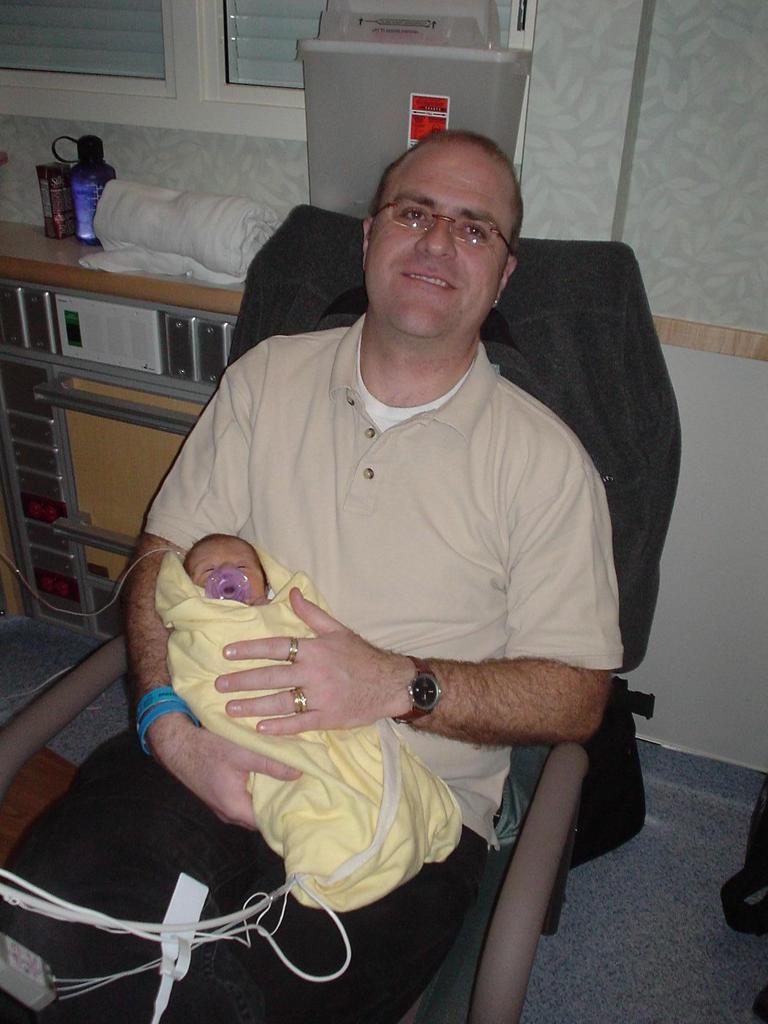
We’re just back from the hospital where little Charlotte is stable and resting peacefully. Aside from an NG tube providing food, she is only on “things that beep,” as I put it, monitors on her vitals. Her own systems are functioning well and she’s a fighter.
We got to give her a bath tonight and Philippe is finally changing diapers. She’s a little peanut. So cute and easy that the PICU nurses are practically fighting over getting onto her schedule.
The update—surgery is scheduled for tomorrow morning, first case. We expect to be at the hospital before 7 am to spend some more time with her before she is taken to the surgical suite. The surgery will take 4+ hours. We’ll be updated hourly by a nurse practitioner. Please keep our little Sprout in your thoughts as you start your week.
Saturday, May 14, 2005
Sprout Has Arrived

Sprout has arrived. Charlotte Alice Geyskens was born on May 9, 2005 at 7:56 pm Chicago time. She was 4 weeks early, but weighed in at a healthy 5 lbs 2 oz and 43 cm long. It was quite an adventurous day and, as we say in marketing, an unexpected delight to meet our daughter a bit early.
Charlotte is doing as well, if not better, than can be expected at this time. She’s happily settled in at Children’s Memorial Hospital (no visitors, flowers, balloons, etc. please) where the nurses love her and she’s getting oodles of attention. She’s been breathing on her own from the beginning; getting nutrition through the world’s tiniest NG tube, but otherwise only hooked to monitors; no IV or anything.
Needless to say, she is adorable, gorgeous, and has a beautiful disposition. Philippe swears she’s already smiling at him. And for those of you who know Philippe’s theory on diaper-changing (he would never change anyone’s but his own child’s), Philippe is now an expert tiny diaper changer. Looks like I finally have competition for his attention.


Subscribe to:
Posts (Atom)

 Posts


